Bingo maker
Card 1
Every card is different and carries its number, so the caller can check a win without seeing the card.
Themes — one tap swaps the words and colours
One link, a different card on every phone
Send this link to the group chat or paste it into the meeting. Each phone that opens it deals its own card and shows its card number. Nobody signs in, and no names are collected.
- 1Send the link. Everyone opens it on their phone.
- 2Open here, and share this screen or put it on the TV.
- 3Players tap squares as they are called. A winner reads out their card number; you check it.
Press Next to make the first call
—
Last calls
Called so far
Paying out cash? Work out each prize with the Tambola prize calculator.
No ads on the caller. Space bar makes the next call. The screen stays awake while a round is running.
Tambola tickets: print Housie tickets free, and call the numbers
Print free Tambola tickets in seconds, no sign-up. Every ticket follows the standard rules, carries its own number, and can be checked from the caller screen. Print them, or send one link and play on phones.
Diwali Tambola Party Kit
The tool above is free and always will be. If you would rather not set a game up yourself, this pack is already done: print it, cut it, play.
- Two ready games of 60 tickets, twelve to a page
- 90 number calls to read out, one for every number
- House rules and a prize split for any pot
- A caller's sheet and a claim log for each round
- Six prize slips to cut out and hand over
- A QR code that opens the caller for these exact tickets
$4.99
One payment · instant download · A4 and US Letter PDFs
Secure checkout by Gumroad, without leaving this page. Buying a pack is what keeps the free tools free.Every detail of this pack
More packs for this tool
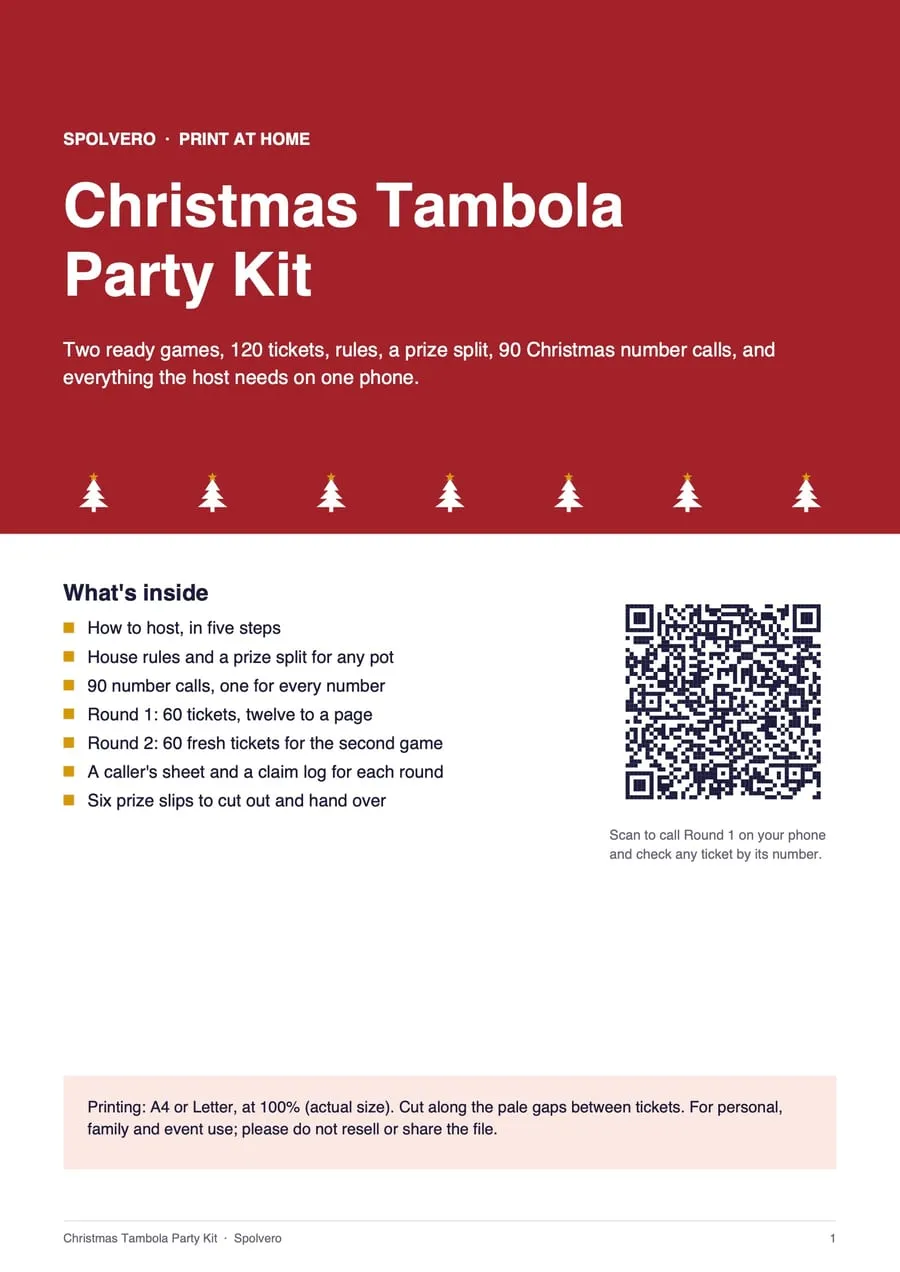
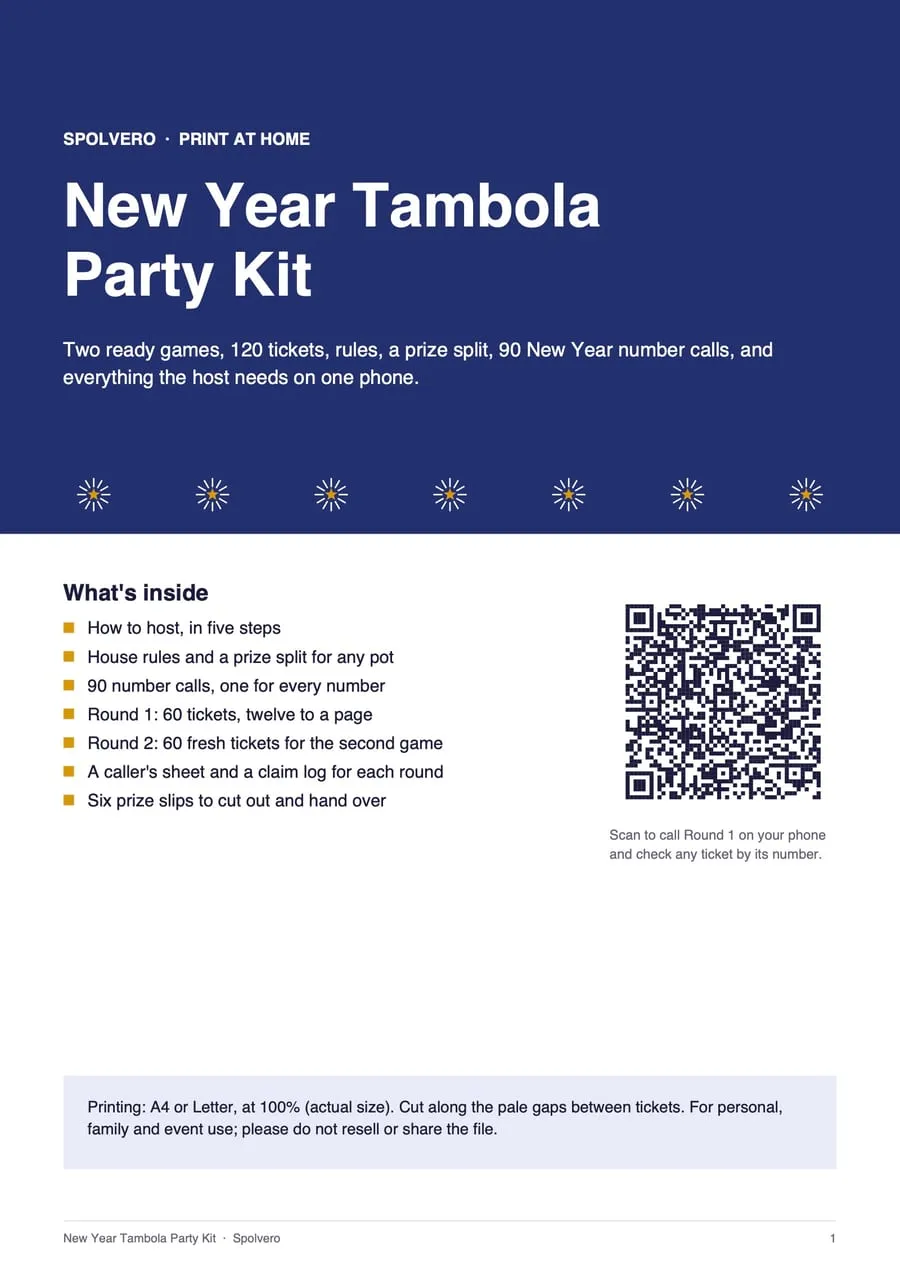
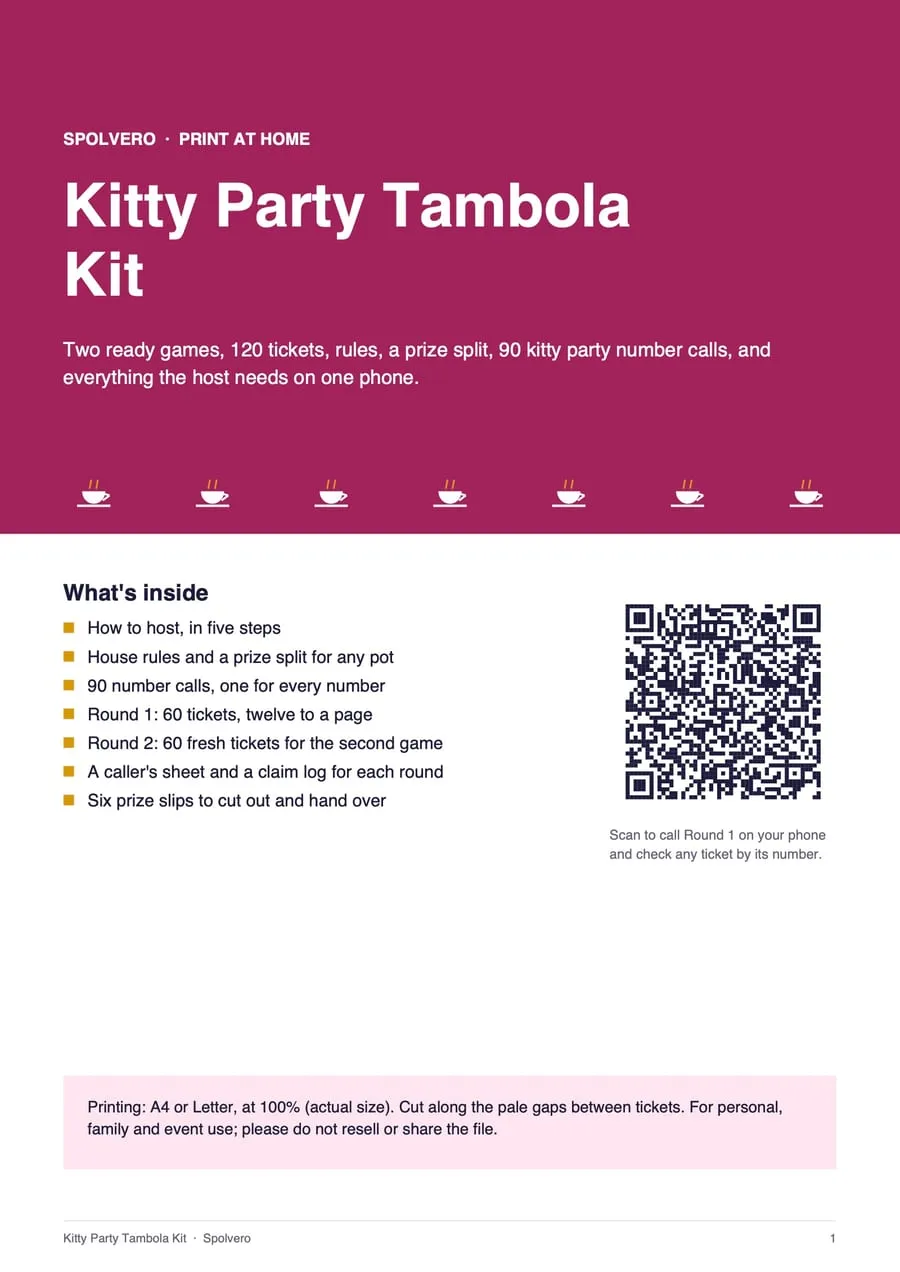
The short answer
A Tambola ticket is a 3 × 9 grid holding 15 numbers from 1 to 90, five in each row. Each column holds its own range — 1–9, 10–19, up to 80–90 — with between one and three numbers, rising from top to bottom. The caller draws 1 to 90 at random; prizes go to early five, each line, and full house.
From list to a game in four steps
Step 1: Choose how many tickets
One ticket per player, or two each for a longer game. Every ticket carries its own number.
Step 2: Print 3, 6 or 12 to a page
Six a page on A4 is the usual size. The last page is a 1–90 sheet for the caller to tick.
Step 3: Call on the TV or a phone
The caller draws 1–90 at random, shows the number large, and reads it aloud in English.
Step 4: Check claims by ticket number
Type the ticket number: it shows the ticket with called numbers marked and names any prize it has won.
Tambola prizes, and how each is won
Agree which prizes you are playing for before the first number. The caller screen checks every one of these from the ticket number.
| Prize | What completes it | Notes |
|---|---|---|
| Early five | The first player to mark any five numbers on their ticket. | Smallest prize, often won inside 15 calls |
| Top line | All five numbers in the top row. | Line prizes are usually equal |
| Middle line | All five numbers in the middle row. | — |
| Bottom line | All five numbers in the bottom row. | — |
| Four corners | The first and last numbers of the top and bottom rows. | Optional; many groups add it |
| Full house | All fifteen numbers on the ticket. | The largest prize, and the end of the game |
Playing for money? The Tambola prize calculator splits the pool into rupees for each of these, adding up exactly.
Calls until the first winner
Measured, not guessed: these are the median results of 200 games per row, dealt by the same engine that makes your cards, with every card checked after each call.
| Players | Early five | First line | Full house |
|---|---|---|---|
| 10 | 15 calls | 44 calls | 76 of 90 |
| 20 | 13 calls | 39 calls | 73 of 90 |
| 30 | 12 calls | 36 calls | 72 of 90 |
| 50 | 11 calls | 33 calls | 70 of 90 |
At one call every ten seconds, a 30-player game reaches full house in about 12 minutes. More players end every prize sooner, because more tickets are racing for it.
Four things worth knowing
Agree the prizes before the first call
Early five, top, middle and bottom line, and full house is the usual set. Decide the prize for each before you start, so no one argues over it later.
Check a claim before the next number
A claim only counts on the numbers already called. Checking by ticket number on the caller screen takes a few seconds and settles it.
Play a practice round with the children
Young players learn the grid quickly with one short game for early five only. It also shows everyone how the caller screen works.
Cast the caller to the TV
At a family gathering, putting the caller on the television means no one needs to shout and everyone can see what has been called.
No accounts, no player data
Cards and the PDF are made by your own browser. Phone play works without a server at all: the game travels in the link after the # mark, which browsers never send anywhere, and each phone deals its own card from the game number. The caller checks a win by dealing the same card again from its number. There is no list of players, because there is nowhere for one to be kept.
- No sign-up for the host or the players
- No names collected, ever
- Your word list never leaves the device
- No ads on the caller or on players' cards
- No ads printed on the PDF
Questions people ask
Anything we've missed?
What are the rules for a Tambola ticket?
Three rows and nine columns; fifteen numbers in all, five in each row; column one holds 1–9, column two 10–19, and so on to 80–90 in the last; each column has between one and three numbers, in ascending order from top to bottom. Every ticket here follows all of those rules.
Is Tambola the same as Housie?
Yes. Tambola, Housie and Housey-Housey are the same 90-ball game. It is the Indian and British cousin of US bingo, which uses 75 balls on a 5×5 card.
What prizes are there in Tambola?
Usually early five (any five numbers), top line, middle line, bottom line and full house (all fifteen). Four corners is a common extra. The caller screen checks all of them from the ticket number.
What features does the Tambola caller have?
It draws 1 to 90 at random, shows each number large enough for a TV, reads it aloud in English, and checks a claim when you type the ticket number, naming any prize the ticket has won.
Does the caller read the numbers aloud?
Yes, in English through your browser's own voice, digit by digit and then the number — "four, two, forty-two" — the way numbers are called in a hall. You can turn the voice off.
Are the cards actually different from each other?
Yes. Each card in a game is checked against every card before it, and a repeat is thrown away and redrawn, so no two card numbers in one game carry the same squares in the same places. With a small word list the cards will still share many words — they simply sit in different places.
How do I check a winner?
Every card is printed with a card number and a game number. On the caller screen, type the card number into Check a card: it rebuilds that card from the game number, marks what has been called, and names any line, corners or blackout it has completed. You never need to collect the card.
Does anything get uploaded?
No. The cards and the PDF are made in your browser. Phone play works by putting the game in the link itself, after the # mark, which browsers do not send to any server. There are no accounts and no player names.
Guides worth reading
- Tambola
Diwali Tambola party: how to host it, what to give as prizes and what to print
A Diwali Tambola plan for a family or office party: how many tickets to print, how to split the pot, prizes to give and how to keep a round to 30 minutes.
7 min read - Tambola
Printable Tambola tickets PDF: how to make them free, and when a ready kit is worth it
How to print proper Tambola (Housie) tickets as a PDF for free, what a correct ticket looks like, how many to a page, and what a paid party kit adds on top.
6 min read - Tambola
Breakfast, lunch and dinner in Tambola: what they mean and how to check a claim
Breakfast, lunch and dinner are three Tambola prizes for the left, middle and right thirds of the ticket. The numbers each covers and when each is won.
6 min read


More ways to play
Bingo Card Generator
Type your words or pick a theme, and print as many unique cards as you need.
Baby Shower Bingo
Guests mark the gifts as the parent-to-be opens them.
Virtual Bingo
Share one link in the chat.
Tambola Prize Calculator
Every dividend in rupees, adding up exactly.
Kitty Party Chits
Print folded chits, or draw one on screen.
Running the evening with a timer too? The timers go fullscreen with no ads. See every game on the Play page.