Keyboard and mouse test
Press any key. Keys turn green once they register.
Tap a suspect key slowly, about 40 times, one deliberate press at a time. A human cannot release and press the same key this fast, so anything flagged here is the switch bouncing.
- No chatter found yet.
Held now
0
Most at once
0
Hold keys down together and keep adding more. W, A, S, D, Shift and Space is a realistic start.
- Left0
- Middle0
- Right0
- Back0
- Forward0
Click, right-click, middle-click and scroll inside this box.
Keys with a dashed outline, media keys and brightness keys are handled before the browser sees them, so they cannot light here. Nothing is stored or sent. Even so, never type a password into a keyboard tester.
Keyboard test: every key, plus chatter and ghosting
Press keys and watch them turn green. Then use the tabs to catch a key that double-types, count how many keys register at once, or check your mouse buttons.
Best keyboard for a laptop with dead keys
Affiliate links
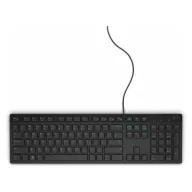
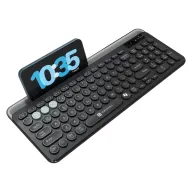
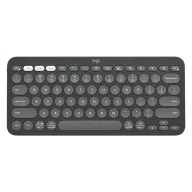
When laptop keys die or type twice, an external keyboard is the quickest fix and costs less than most keyboard repairs. The wired Dell KB216 is the cheapest dependable choice, the Portronics Bubble 3.0 adds wireless and a number pad, and the Logitech Pebble Keys 2 K380s is the slim one to carry with the laptop.
Budget · Under ₹700
Dell KB216 wired keyboard
The cheapest dependable fix: plug it in and type. Full size, with a number pad and media keys.
See it on Amazon IndiaMid-range · Under ₹1,000
Portronics Bubble 3.0 wireless keyboard
Wireless with a number pad, rechargeable, and able to switch between three devices.
See it on Amazon IndiaBest to carry · Under ₹3,500
Logitech Pebble Keys 2 K380s
Slim enough to carry in the laptop bag, and it pairs with three devices at once.
See it on Amazon India
Picked from Amazon.in best sellers rated 4 stars or more. Spolvero may earn a commission.
The short answer
To test a keyboard, press every key and watch the on-screen layout fill in. A key that never lights is not reaching the browser, which points at the hardware, the connection or a driver. A key that turns red is chattering — one press registering twice, usually a worn or dirty switch. A key that turns amber has been held for three seconds and may be stuck.
Four things worth knowing
Pick the layout you actually own
ANSI, ISO, Mac, laptop and 60% boards put keys in different places. Choose yours so the untested count means something — a 60% board has no F row to miss.
Prove chatter with slow, single presses
Double-typing is intermittent. On the Chatter tab, tap the suspect key about forty times, one deliberate press at a time. A human cannot release and re-press within 50ms; a bouncing switch does.
A dark key is not always broken
Fn, media keys and screen brightness are handled by the keyboard or the operating system before the browser sees anything. They are drawn with a dashed outline so you do not chase them.
Copy the summary for a warranty claim
The Copy summary button gives a dated, plain-text list of untested, chattering and stuck keys. Paste it into a support ticket or an RMA form instead of describing the fault from memory.
Nothing leaves your device
This test runs entirely in your browser. There is no upload, no recording and no server that could receive anything — close the tab and it is gone.
- No sign-up and no account
- Nothing recorded or stored
- Works with an ad blocker on
- Free, and staying free
Questions people ask
Anything we've missed?
Are my keystrokes recorded?
No. Keys are read to light the layout and count presses, and nothing is stored or sent. The summary goes to your clipboard only when you press Copy. Even so, do not type passwords into any keyboard tester — it is a habit worth keeping.
Why does my keyboard type letters twice?
That is switch chatter: the metal contact bounces as it closes and the keyboard reads two presses. The Chatter tab flags any press that follows a release faster than a finger can move. Cleaning helps if it is dirt; a worn switch needs replacing, or a longer debounce setting in the keyboard's software.
Some keys never light up. Is the keyboard broken?
Not necessarily. Media keys, brightness keys and Fn are intercepted before the browser sees them. A letter, number or modifier that stays dark after you press it is a genuine problem.
How do I test for a stuck key?
Take your hands off the keyboard and watch. A key held down for more than three seconds turns amber and is counted as stuck. Debris under the cap is the usual cause.
How many keys can my keyboard press at once?
Open the Rollover tab and hold keys down together, adding more one at a time. The page shows the most it saw at once. Six or more is fine for almost every game; three to five means some combinations will ghost. The browser shows a floor, not the keyboard's true maximum.
Can I test my mouse here too?
Yes. The Mouse tab counts left, right, middle, back and forward clicks and scroll steps, flags two clicks arriving faster than a finger can make them — the classic double-click fault — and runs a five-second click speed test.
Test it for something specific
Other device tests
- Live
Webcam Test
Check your camera in 3 seconds.
- Live
Online Mirror
A mirror with light, zoom and Ghost Pose.
- Live
Voice Recorder
Record, trim, download. Nothing uploaded.
- Live
Teleprompter
Read your script while you record.
- Live
Bingo Card Generator
Unique cards in a minute. Call it on screen.
- Live
Tambola Tickets
Proper 3×9 tickets, and a 1–90 caller.
- Live
Tambola Prize Calculator
Every dividend in rupees, adding up exactly.
- Live
Kitty Party Chits
Print folded chits, or draw one on screen.
- Live
Virtual Piano
Play, learn a song, record it.
- Live
Photo Jigsaw Puzzle
Any photo, 12 to 300 pieces.
- Live
Poster Maker
Any picture, wall-sized, on A4 or Letter.
- Live
Chart Maker
Any photo as a chart you can stitch.
- Live
Row Counter
Never lose your row again.
- Live
Photo Metadata Remover
See what your photos give away, then remove it.
- Live
Change Photo Date
Fix a wrong camera clock for a whole trip.
- Live
GST Calculator
Add or remove GST, with the CGST and SGST split.
- Live
Speech Time Calculator
How long your speech runs, or how many words to write.
- Live
Exam Time Calculator
Minutes per mark, and a finish-by time for each section.
- Live
Ring Sizer
Lay a ring on the screen, read five size systems.
- Live
Bangle Sizer
Lay a bangle on the screen, or measure your hand.
- Live
Online Ruler
A real-size ruler, once you match a card.
- Live
Mic Test
Hear yourself before they do.
- Live
Speaker Test
Left, right, and is it loud enough?
- Live
Mouse Test
Catch the double-click fault before you blame the software.
- Live
Dead Pixel Test
Check a new screen before the return window closes.
- Live
Laptop Check
Nine checks, fifteen minutes, one printed record.
- Live
Kundli Maker
Lagna, grahas, nakshatra and dasha.
- Live
Birth Chart Calculator
Sun, Moon and rising sign, with the wheel.
- Live
Today's Horoscope
Read from where the Moon is right now.
- Live
Today's Panchang
Your city's tithi, nakshatra and sunrise.

Find the problem now, not mid-sentence
Every one of these runs in the browser and checks one thing properly. Nothing is uploaded, nothing is recorded, and none of them need an account.
Guides worth reading
- Keyboard
Keyboard ghosting test: what ghosting and n-key rollover mean, and how to check yours
Why some key combinations drop a press, what 2KRO, 6KRO and NKRO mean, how many keys you actually need at once, and how to test your keyboard in a browser.
6 min read - Keyboard
Keyboard keys not working or typing twice: how to find out why
A dead key, a key that types twice and a key that repeats on its own are three different faults. How to tell them apart in two minutes, and what fixes each one.
6 min read
