Diwali Tambola party: how to host it, what to give as prizes and what to print

The short answer
Print two tickets per guest, agree six prizes before the first call (early five, three lines, four corners and full house), and call a number every ten to fifteen seconds so a round lasts 20 to 30 minutes. Check every claim from the ticket number before the next call. Two rounds fills an evening between dinner and the fireworks.
Tambola is the one game every generation at a Diwali party will sit down for. Grandparents know it as Housie, children learn it in one round, and nobody has to be picked for a team. The host’s job is to make it fair, keep it moving and have the prizes ready. This is the plan.
Decide the prizes before anyone sits down
Every argument in Tambola is about a prize somebody thought was still open. Agree the list before the first number is called and read it out at the start. Six prizes suits a Diwali crowd because more people go home with something:
- Early five. The first ticket with any five numbers marked.
- Top line, middle line, bottom line. All five numbers in that row.
- Four corners. The first and last numbers of the top row and of the bottom row.
- Full house. All fifteen numbers. Always last, always the biggest.
If you are playing for a pot, a split that works for any amount is 10% for early five, 12% for each line, 14% for four corners and 40% for full house. For a family game where the money would feel wrong, the same list works with gifts: a diya set and a box of sweets for the small prizes, something bigger for full house.
Print two tickets per guest
Beginners and children play one ticket. Regulars want two or three so they always have something to mark. Two per guest is the average that keeps everyone busy without slowing the caller down.
The Tambola Tickets tool prints proper 3×9 tickets, fifteen numbers with five in each row, three, six or twelve to a page. Twelve to a page is the cheapest to print and the easiest to cut, because every ticket is the same size and the gaps line up. Print at 100%, not “fit to page”, so the tickets come out at the size the cut lines expect.
Keep a handful of spare tickets. Somebody always arrives after the first round has started.
Pick a caller who can keep a pace
The caller is the whole game. Too slow and the room drifts back to conversation; too fast and someone misses a number and disputes the full house. One number every ten to fifteen seconds is right: say the number, say it again, and move on.
Call the number, not just the rhyme. “Legs eleven” is fun; “legs eleven, number eleven” is fair. With children in the room, hold up fingers or point at the number on the caller’s screen for the smallest players.
The caller also needs a record of what has been called. If you draw from a bowl, keep the drawn slips in order on the table. If you use the caller on a phone or laptop, the drawn numbers stay on screen and the check is automatic.
Check every claim from the ticket number
When someone shouts “Full house!”, the room stops. The check has to be quick and it has to be right.
Every ticket the tool prints carries a ticket number. Type that number into the caller’s Check a ticket box and it rebuilds the ticket and shows which prizes it has completed against the numbers called so far. You never have to walk over, collect the ticket and read fifteen numbers aloud while everyone waits.
Two house rules stop most disputes:
- Claim before the next call. A claim made after the next number is drawn does not count. Say this at the start.
- A wrong claim is a bogey. Decide what a bogey costs before you begin: the player sits out one prize, or pays a small fine into the pot. Most families make it a laugh rather than a penalty.
Plan two rounds, not one
A round of 90 numbers takes 20 to 30 minutes. One round feels short once everyone is warmed up; three drags into the fireworks. Two rounds with a break for snacks is the sweet spot for a Diwali evening.
The second round needs fresh tickets. Playing the same tickets again means the same people are close to the same prizes, and everyone knows it. Print a second set with a new game number, or use the second game in the kit.
The printable kit, if you would rather not make anything
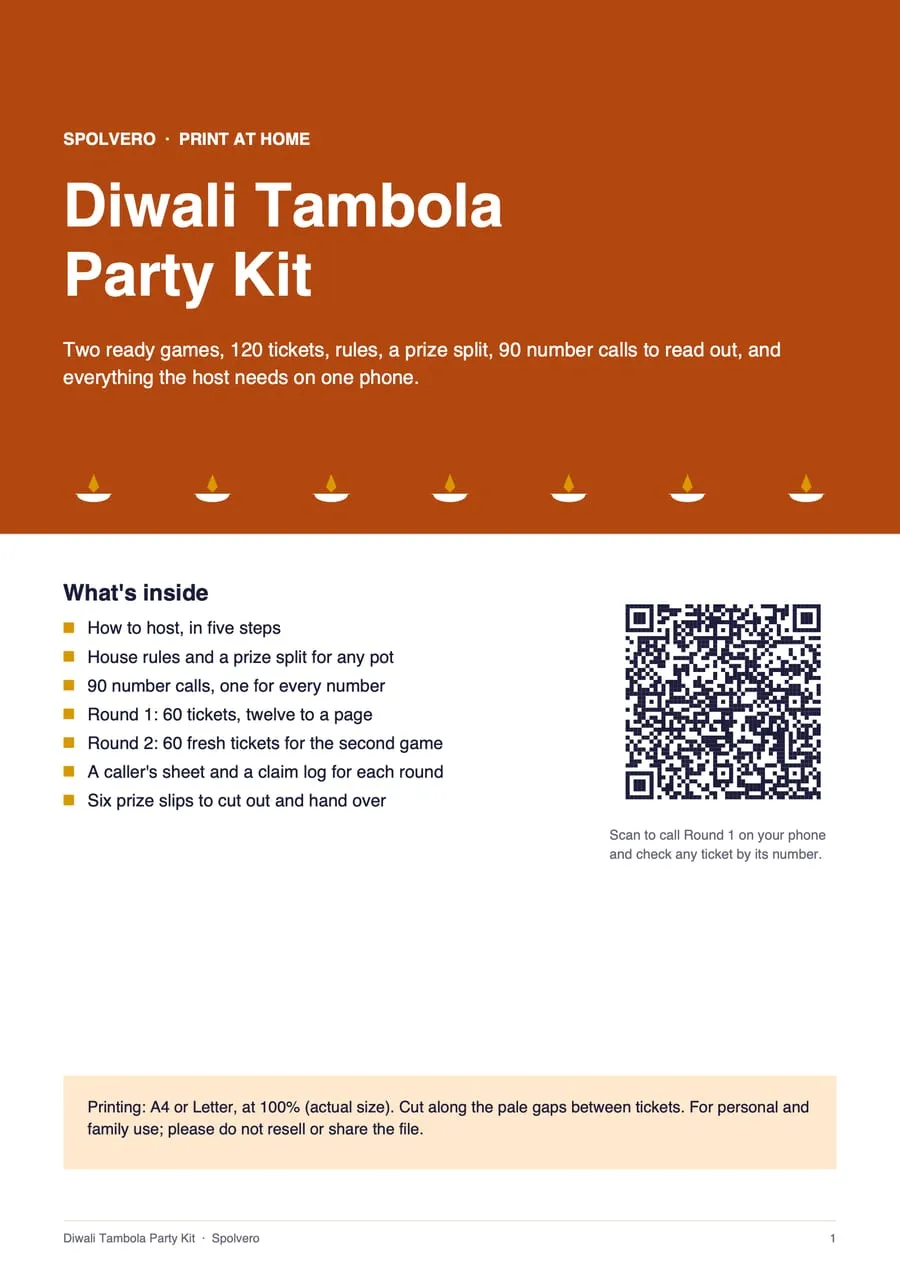
The free tool prints tickets and runs the caller, and that is genuinely all a game needs. The Diwali Tambola Party Kit is for the host who wants the rest done: two ready games of 60 tickets, the house rules and prize split on one page, 90 number calls written for Diwali, a caller’s sheet and claim log for each round, and six prize slips to hand over. Scan the QR code on its cover and the phone becomes the caller for those exact tickets.
Either way, the game is the same. Print, cut, pour the chai, and let the oldest person in the room call the first number.
Related guides
- How to organise Tambola at home covers the pace, the prize pool and checking claims in more depth.
- Tambola games list has fifteen prize patterns if six is not enough for your crowd.
- Tambola
- Party games
- Diwali