Printable Tambola tickets PDF: how to make them free, and when a ready kit is worth it

The short answer
A correct Tambola ticket is a 3×9 grid with fifteen numbers, five in each row, and each column drawn from its own ten numbers (1–9, 10–19, up to 80–90). The free Tambola Tickets tool makes as many as you need as a PDF, three, six or twelve to a page, each with a ticket number the caller can check. A ready kit adds the rules, number calls, claim logs and prize slips.
Search for printable Tambola tickets and you find two kinds of result: a scanned sheet of tickets that everyone at the party has already seen, and generators that make tickets with the wrong number of squares. This guide covers what a correct ticket is, how to print a set for free, and what you are actually paying for when you buy a kit.
What a proper ticket looks like
A Tambola ticket, also called a Housie ticket, is a grid of three rows and nine columns with fifteen numbers, five in each row. The other twelve squares are blank.
Each column draws from its own ten numbers: the first column holds 1 to 9, the second 10 to 19, the third 20 to 29, and so on, with the last column holding 80 to 90. Within a column the numbers run in ascending order top to bottom. That layout is what makes the game work: a caller reading “forty-three” sends every eye to the fifth column, and a full house needs all fifteen.
Tickets that break these rules, with four numbers in a row or a column out of range, are the reason some downloaded sets produce two full houses on the same number. Check any free set against the rule before you print forty of them.
Print a set for free
The Tambola Tickets tool builds tickets to the standard rule and writes them to a PDF you print at home:
- Choose the count. Two tickets per player is the usual amount. Add a few spare.
- Choose the layout. Twelve to a page at the usual size, six for larger print, or three big tickets for children.
- Download the PDF and print at 100%, or “actual size”. Do not let the printer scale to fit, or the cut lines move.
- Cut along the gaps between tickets. Each ticket carries its own number.
That number is the useful part. The same page has a caller that draws 1 to 90 in random order and reads each number aloud. When a player shouts, type their ticket number into Check a ticket and it rebuilds the ticket and shows which prizes it has completed. No collecting tickets, no reading fifteen numbers to the room.
Every game the tool makes has a game number. Print a second batch with a new game number for a second round, so the near-complete tickets from round one are not back in play.
Twelve, six or three to a page
| Layout | Ticket size | Best for | Twenty players, two each |
|---|---|---|---|
| Twelve to a page | Small, standard | Adults, big rooms, cheapest | 4 sheets |
| Six to a page | Medium | Mixed ages, older players | 7 sheets |
| Three to a page | Large | Children, first games | 14 sheets |
Twelve is what most hosts want. It cuts cleanly because every ticket is the same size and the gaps line up in both directions.
When a ready kit is worth it
The free tool prints tickets and runs the caller, and for a game between friends that is everything. A party kit is for the host who wants the rest of the evening’s paper done as well:
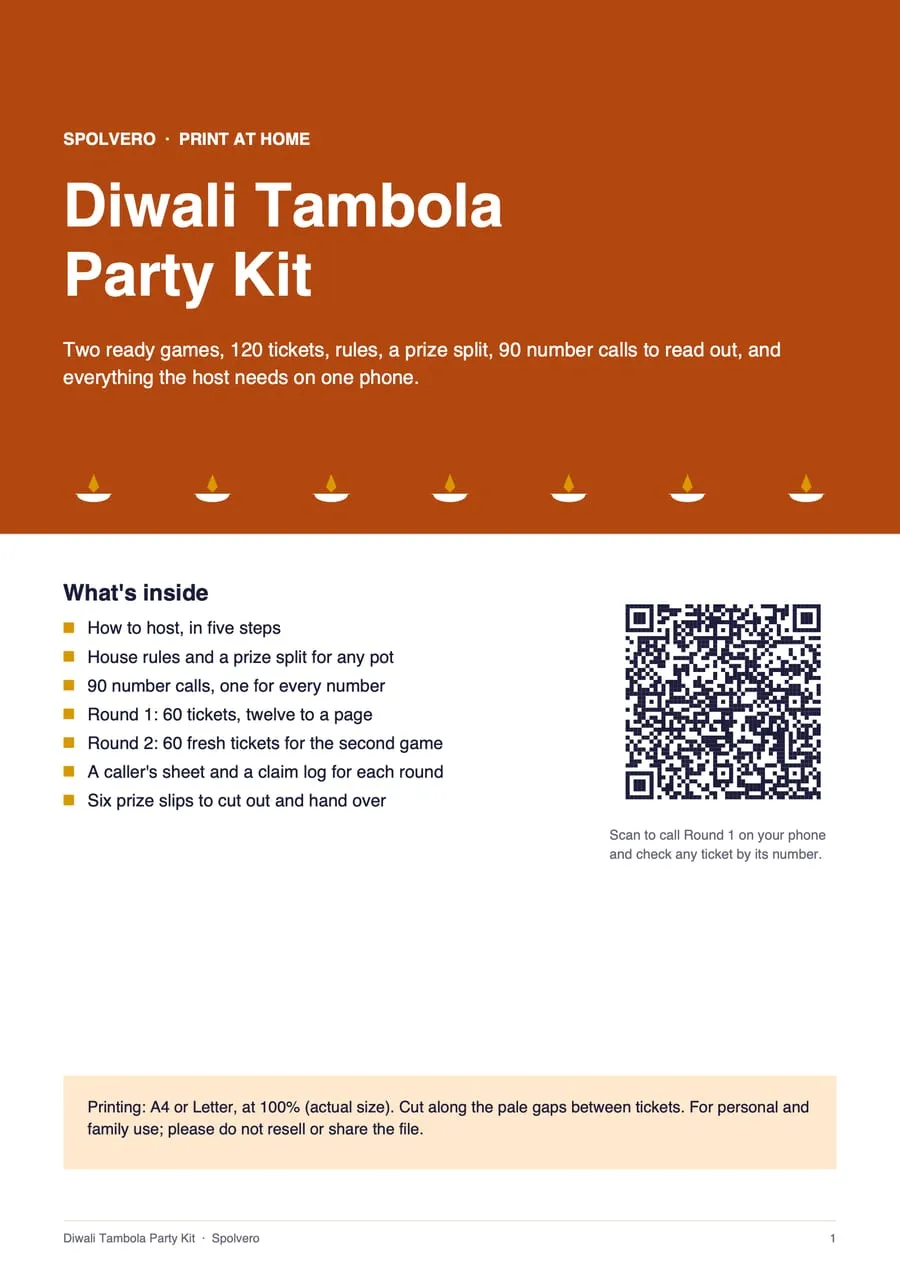
- Two ready games of 60 tickets, twelve to a page, so round two is a fresh draw.
- House rules and a prize split on one page to read out before the first call: early five, three lines, four corners and full house, with a percentage for each that works for any pot.
- 90 number calls, one for every number, written for the occasion. The part that takes longest to make yourself.
- A caller’s sheet and a claim log for each round, for hosts who draw from a bowl.
- Six prize slips to cut out and hand to winners.
- A QR code on the cover that opens the caller, already set up for those exact tickets, on any phone.
It comes as A4 and US Letter PDFs, and the caller it links to is the same free tool. If you only need tickets, use the tool. If you are hosting thirty people and want to spend the afternoon cooking rather than formatting, the kit is the shortcut.
Related guides
- How to organise Tambola at home covers the pace, the prize pool and checking claims.
- Tambola games list has fifteen prize patterns and which to play in one game.
- Tambola
- Printables